AntTRAILS
The genomic legacy of major human transitions in Mediterranean ants across history
- 1
- 10
- 50
- 150
Pheidole species recorded per 300 km cellKass et al. 2022
01The ant
The big-headed ants
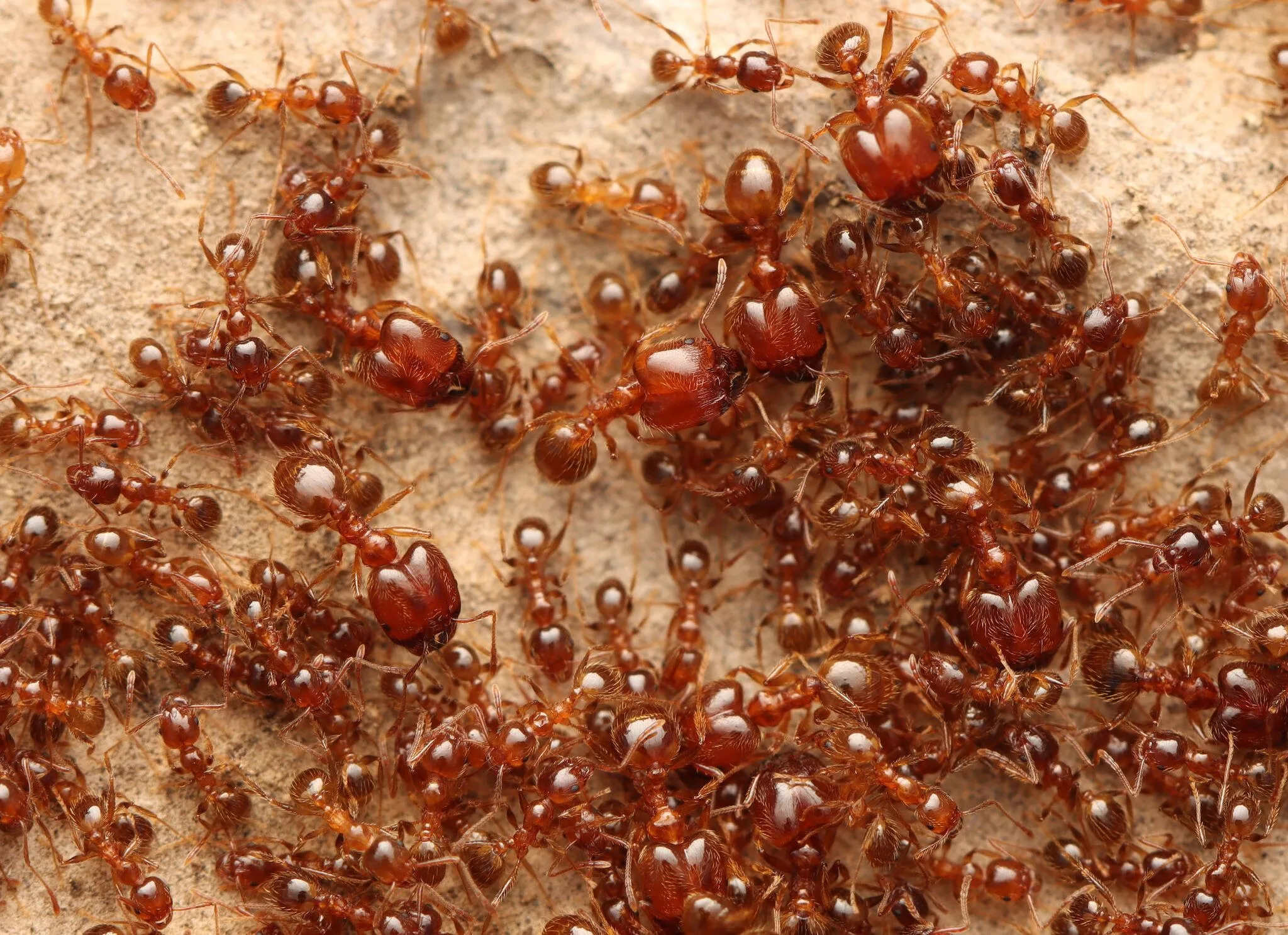
Pheidole is one of the largest genera of ants, more than 1,100 species are known. A colony raises two worker castes from the same mother: small minors, which do most of the work, and larger majors, whose oversized heads are packed with mandible muscle, a bite strong enough to open food the minors cannot. In some species the majors also serve as living reservoirs, storing food in their gasters.
02The name
The Mediterranean big-headed ants
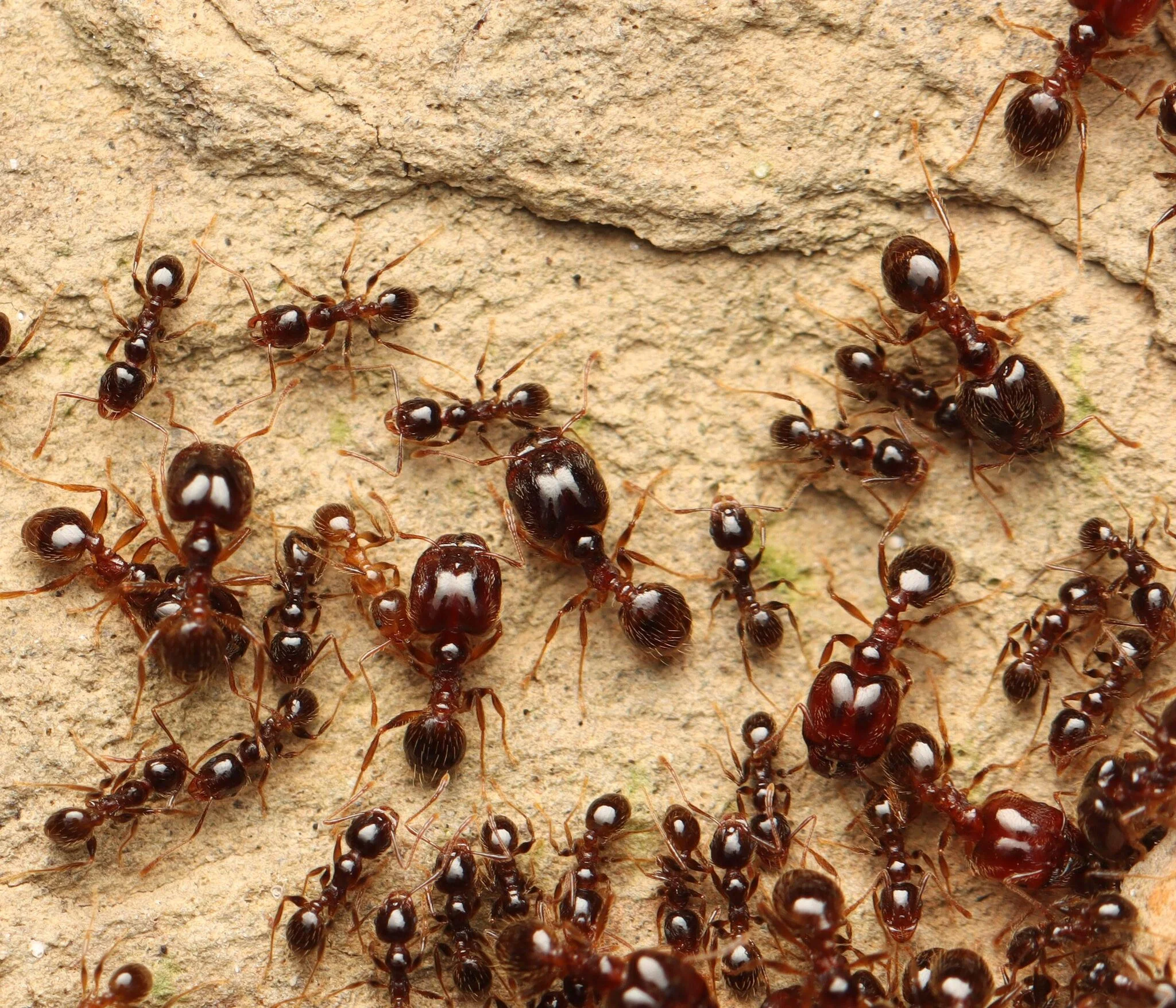
Around the Mediterranean the common native one is small, running from pale to dark brown, and it is everywhere: under stones, along paths, in the cracks of every city in the basin.
For more than a century and a half it was considered a single species. Everything from Portugal to the Caucasus was called Pheidole pallidula.
- Pheidole pallidula
03The revision
From one to four cryptic species
In 2016 Bernhard Seifert measured 287 major workers from 112 nests across seventeen morphometric characters and found four species inside that one name. Three of them overlap broadly in the Balkans and Asia Minor.
Pheidole pallidula group
- P. pallidula
- P. cicatricosa
- P. balcanica
- P. koshewnikovi
04The question
Everything moved
Since the rise of civilisation people have carried other species with them, occasionally on purpose and far more often by accident. Ants travel with us particularly well: they like the places we build, they eat what we produce, and they are small enough to arrive unnoticed.
Some of the oldest and busiest of those routes run along the same coasts where these species meet.
A distribution map cannot say whether a population has always been there. A genome can, and that is what AntTRAILS sets out to read.
- 600–500 BCEThe Levant and the Red Sea
- 350 BCEThe Hellenistic world
- 150–200 CERoman sea lanes
- 200 CERoman roads and sea
- 1300–1500 CEEurope, the Levant and North Africa
Routes after OWTRAD (Ciolek 1999), CC BY-NC.
Straight lines between ports.
- P. pallidula
- P. cicatricosa
- P. balcanica
- P. koshewnikovi
05The aim
What AntTRAILS asks
- How many, and whereFour species were told apart by linear morphometry. A genome can test whether they really are four, and show where each one lives.
- Which were carried, and whenSome populations have always been there, others came with people. Their genomes can tell the two apart, and roughly when the newcomers arrived.
- What happens where they meetThree of the four live side by side across wide areas. Do they still interbreed where they meet, and how has that shaped them?
06The model
Why the Mediterranean big-headed ants
- CommonAmong the most widespread ants in the region, and easy to find and collect.
- At home with usThey live in the places we build and eat what we grow, so they have always had the chance to travel with us.
- CrypticThe four are told apart by morphometry rather than by eye, so one arriving where another already lives can pass for it.
- Together and apartThe species meet in some areas and not in others, which is what makes gene flow possible to measure.
- Deeply dividedMore than fifteen percent divergence between mitochondrial lineages, apparently even within the same species: enough resolution to read populations, not only species.
- Its own controlOther Pheidole live here too: recent arrivals like P. megacephala and P. indica, and one native from another group, P. sinaitica.
07The sampling
What we collected
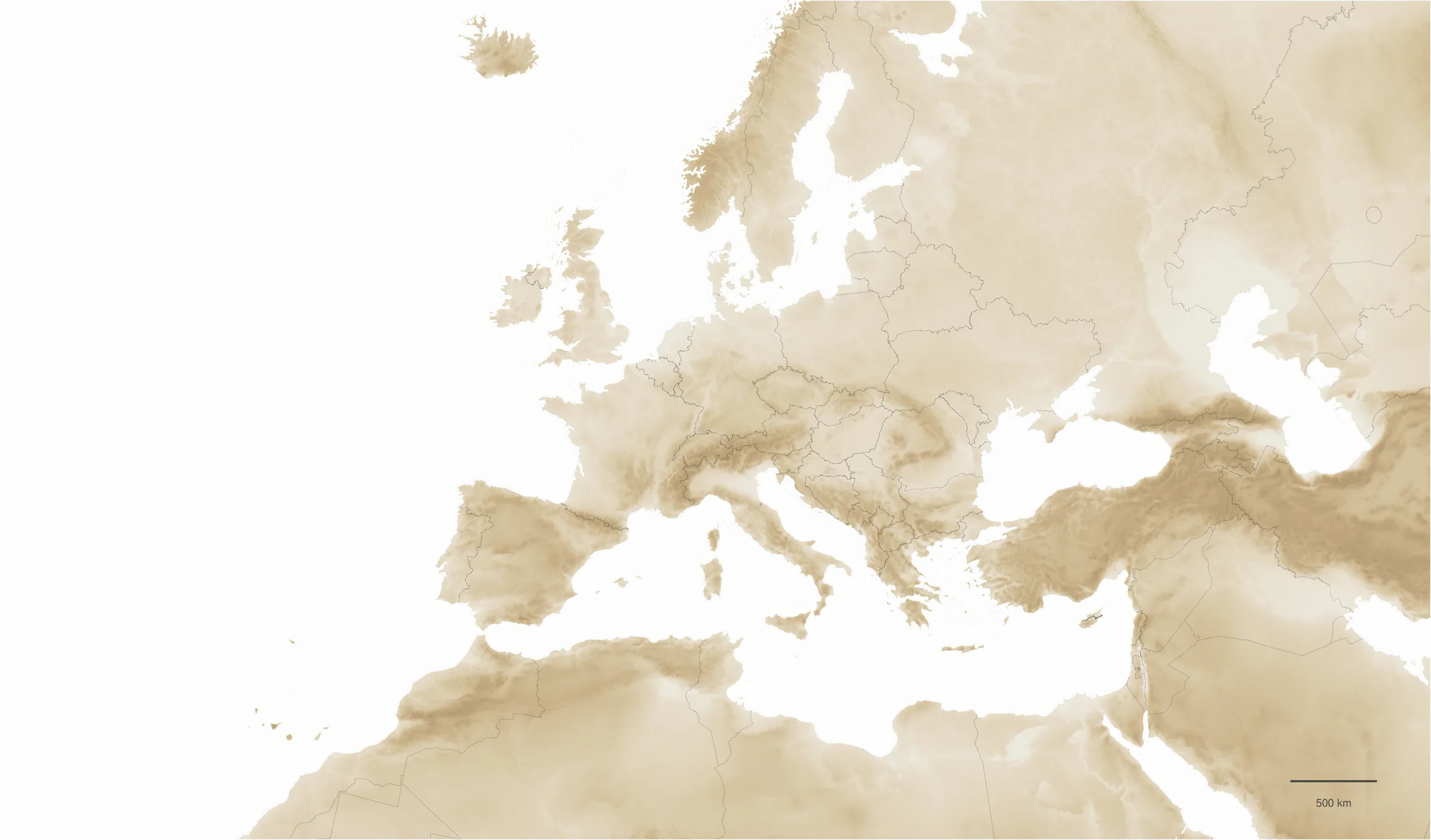
All the specimens going through the lab, plotted over the four supposed native ranges. Including many introduced populations.
08The people
The team
- Mattia MenchettiMuseum für Naturkunde, Berlin, Germany
- Bonnie BlaimerMuseum für Naturkunde, Berlin, Germany
- Pablo LibradoInstitute of Evolutionary Biology (CSIC-UPF), Barcelona, Spain
- Jelena BujanRuđer Bošković Institute, Zagreb, Croatia
- Lidya HamechaDepartment SNV, University of Algiers, Algeria
- Celal KaramanTrakya University, Edirne, Türkiye
- Albena Lapeva-GjonovaSofia University, Bulgaria
- Wala OueslatiUniversity of Tunis El Manar, Tunisia
- Sebastian SalataUniversity of Wrocław, Poland
- Elisabetta SbregaInstitut Botànic de Barcelona (IBB), CSIC-CMCNB, Spain
- Enrico SchifaniInstitut de Biologia Evolutiva (CSIC-UPF), Barcelona, Spain
- Ahmed TaheriAbdelmalek Essaâdi University, Tétouan, Morocco
- Roger VilaInstitut de Biologia Evolutiva (CSIC-UPF), Barcelona, Spain
- Jody VogesMuseum für Naturkunde, Berlin, Germany
09Funding
AntTRAILS is funded by the European Union under the Marie Skłodowska-Curie Actions, grant agreement No 101206623, and hosted by Bonnie Blaimer's lab at the Museum für Naturkunde Berlin, with a secondment to Pablo Librado's group at the Institute of Evolutionary Biology in Barcelona.

Seifert, B. (2016) Inconvenient hyperdiversity: the traditional concept of Pheidole pallidula includes four cryptic species (Hymenoptera: Formicidae). Soil Organisms 88(1): 1–17.
Kass, J.M. et al. (2022) The global distribution of known and undiscovered ant biodiversity. Science Advances 8(31): eabp9908. 10.1126/sciadv.abp9908
Ciolek, T.M. (1999–) Old World Trade Routes (OWTRAD) Project. Asia Pacific Research Online, Canberra. ciolek.com/owtrad
Photograph: Pheidole pallidula, Himarë, Albania. Hjalte Kjærby, CC BY-NC, iNaturalist.