Research

What I work on

Two main lines of work, two that run alongside, and one underlying question: how did biodiversity come to be arranged the way it is, and how much of that arrangement can DNA still tell us about?

aCataglyphis hellenica, Greek Desert Ant. Greece. Philipp Hoenle, CC0.bPolyergus rufescens, European Amazon Ant. Czech Republic. Philipp Hoenle, CC0.cCataglyphis bombycina, Saharan Silver Ant. Morocco. Jonghyun Park, CC BY.dMessor marocanus. Morocco. Jonghyun Park, CC BY.eAphaenogaster sicardi. Morocco. Jonghyun Park, CC BY.fCrematogaster scutellaris tenuispina. Morocco. Jonghyun Park, CC BY.gCamponotus cruentatus, Blood-spotted Sugar Ant. Morocco. Jonghyun Park, CC BY.hPonera coarctata, Indolent Ant. Austria. Jonghyun Park, CC BY.iPheidole pallidula. Morocco. Jonghyun Park, CC BY.jTetramorium caespitum complex, Pavement Ants. Greece. Philipp Hoenle, CC0.kMyrmecina graminicola, Woodlouse Ant. Austria. Jonghyun Park, CC BY.
  • DNA barcoding
  • Integrative taxonomy
  • Cryptic diversity
01

Biodiversity discovery

More than 14,000 ant species have been formally described. Their real diversity is probably two or three times that. A great deal of what is missing is not only hiding in unexplored places. It is also hiding in their DNA, in morphometric characters, in our own cities and inside the nests of other ants. Even your garden may hold a discovery.

Species described new to scienceWhere each one lives, its etymology and type locality, and the paper it was described in, on a map.

Finding what is missing means being able to tell species apart in the first place, which is why I built the first comprehensive DNA barcode reference library for European ants: 6,530 sequences covering 506 species, 209 of them sequenced for the first time. Working from it I have described three species new to science.

  • Barcoding the ants of Europe

    6 papers

    A reference library first, then the species it brought out of hiding: populations that had been passing under a familiar name, castes nobody had described, and taxa new to science. Cataglyphis mater, described in 2026, is the most recent. The library has a home of its own at AntGeM, with the team, the sampling and the atlas of mitochondrial diversity behind it.

    • 2026

      Menchetti M.Vila R.

      DNA barcode reference library for European ants: a roadmap for phylogeography and species discovery

      Molecular Ecology Resources10.1111/1755-0998.70135PDF

    • 2024

      Zięcina D.Salata S.

      Taxonomic revision of the Aphaenogaster subterranea species group (Hymenoptera, Formicidae)

      Annales Zoologici10.3161/00034541ANZ2024.74.2.002PDF

    • 2023

      Menchetti M.Vila R.

      Quantitative morphology and mtDNA reveal that Lasius maltaeus is not endemic to the Maltese Islands (Hymenoptera, Formicidae)

      Journal of Hymenoptera Research10.3897/jhr.95.96365PDF

    • 2023

      Menchetti M.Vila R.

      The invasive ant Solenopsis invicta is established in Europe

      Current Biology10.1016/j.cub.2023.07.036PDF

    • 2023

      Schär S.Menchetti M.

      First Record of the Introduced Ant Myrmica specioides In the Eastern United States

      Sociobiology10.13102/sociobiology.v70i4.9153PDF

    • 2020

      Schär S.Vila R.

      Integrative biodiversity inventory of ants from a Sicilian archipelago reveals high diversity on young volcanic islands (Hymenoptera: Formicidae)

      Organisms Diversity & Evolution10.1007/s13127-020-00442-3PDF

aSolenopsis invicta, Red Imported Fire Ant. Mexico. Jonghyun Park, CC BY.bPheidole koshewnikovi, Koshewnikov's Big-headed Ant. Greece. Konstantinos Kalaentzis, all rights reserved, used with permission.cLinepithema humile, Argentine Ant. South Africa. Philipp Hoenle, CC0.dBrachyponera chinensis, Asian Needle Ant. South Korea. Jonghyun Park, CC BY.eAnoplolepis gracilipes, Yellow Crazy Ant. Philippines. Jonghyun Park, CC BY.fWasmannia auropunctata, Little Fire Ant. Papua New Guinea. Philipp Hoenle, CC0.
  • Population genomics
  • Biological invasions
02

Ant invasions and human history

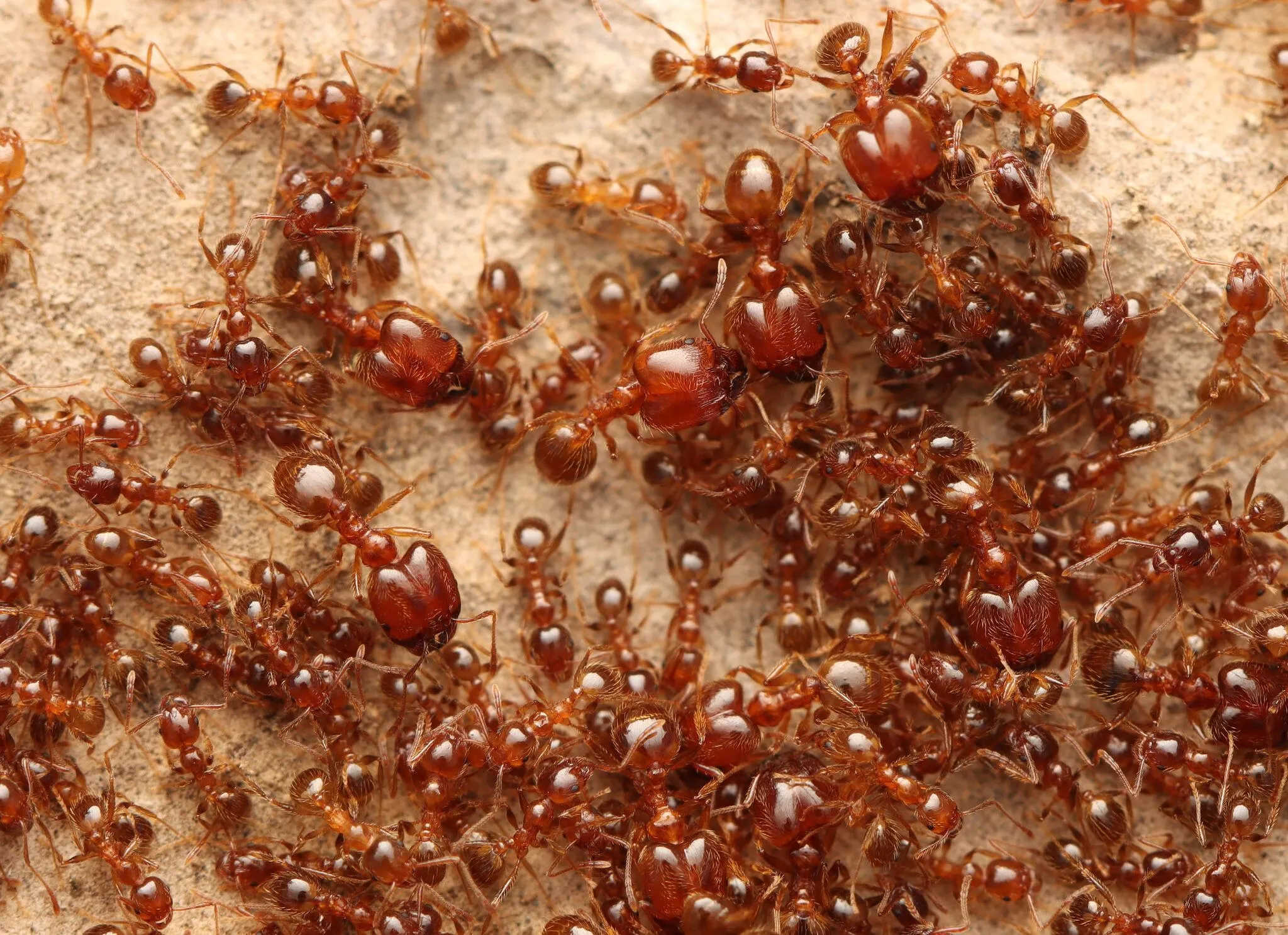
People have been moving species around for a very long time, and ants travel with us particularly well. They like the places we build, they eat what we produce, and they are small enough to arrive unnoticed. The result is that in a region like the Mediterranean it is genuinely unclear not only how many ant species are present, but also which of them are native rather than ones we brought.

First records of introduced antsEvery species I have reported arriving somewhere for the first time, where it turned up and the paper reporting it, on a map.

AntTRAILS sets out to separate the two. It combines high-coverage genome sequencing of Pheidole across the Mediterranean with morphometrics, to work out where introductions came from and which routes species are taking now.

The project is hosted by Bonnie Blaimer's lab at the Museum für Naturkunde in Berlin, with a secondment to Pablo Librado's group at the Institute of Evolutionary Biology in Barcelona.

  • AntTRAILS

    in progress

    The genomic legacy of major human transitions in Mediterranean ants across history.

    Funded by the European Union's Horizon Europe research and innovation programme under the Marie Skłodowska-Curie grant agreement No 101206623.

    The first results are still in preparation.

  • The fire ant invasion in Italy

    2 papers

    Finding the first established population of Solenopsis invicta in Europe, working out where it came from, and arguing for surveillance before the next one arrives.

Alongside the ants

Two lines that run in the background: where I started, and what I keep returning to.

aVanessa cardui, Painted Lady. Finland. Jani Vastamäki, CC BY-NC.bMelitaea cinxia, Glanville Fritillary. Croatia. Philipp Hoenle, CC0.cMelanargia galathea, Marbled White. Germany. Philipp Hoenle, CC0.dAglais io, European Peacock. Türkiye. Ufuk Karaca, CC BY-NC.eLycaena phlaeas, Small Copper. Denmark. Tina Ellegaard Poulsen, CC BY.fCoenonympha arcania, Pearly Heath. France. Yves Bas, CC BY.
  • Phylogeography
  • Glacial refugia
  • Insect migration
  • Conservation
03

Butterfly phylogeography

Butterflies are where I started, and they remain the group whose genetic record runs deepest. Decades of collecting and sequencing mean a population's present-day genetics can be read backwards, towards the refugia it survived in and the routes it took once the ice withdrew.

With colleagues I assembled an atlas of mitochondrial genetic diversity covering Western Palearctic butterflies, then used it to test directly what the Quaternary ice ages left behind. Those long-standing hypotheses about glacial refugia had been enormously influential without ever being examined at continental scale. Along the way we found things like the last Apennine population of Erebia pandrose, genetically unique, isolated across multiple glacial cycles, and unlikely to survive the coming decades.

A separate strand follows the painted lady, Vanessa cardui, whose multigenerational circuit across the Sahara and the Mediterranean runs to roughly 15,000 km. It is the longest migration known in any butterfly.

  • 10kLepGenomes

    7 papers

    A European network assembling reference genomes for 10,000 Lepidoptera, and building the shared standards, training and curation that make a dataset that size usable.

    COST Action CA23122, 2024 to present. Chaired by Niklas Wahlberg, vice-chaired by Vlad Eugen Dinca. Funded by COST, European Cooperation in Science and Technology.

    • 2025

      Wright C. J.Meier J. I.

      Project Psyche: reference genomes for all Lepidoptera in Europe

      Trends in Ecology & Evolution10.1016/j.tree.2025.10.007PDF

    The genomes are published one species at a time:

    • 2026

      Menchetti M.Blaxter M.

      The genome sequence of the Portuguese Dappled White, Euchloe tagis (Hübner, 1804) (Lepidoptera: Pieridae)

      Wellcome Open Research10.12688/wellcomeopenres.25883.1PDF

    • 2026

      Menchetti M.Blaxter M.

      The genome sequence of the Provence Hairstreak, Tomares ballus (Fabricius, 1787) (Lepidoptera: Lycaenidae)

      Wellcome Open Research10.12688/wellcomeopenres.25725.1PDF

    • 2026

      Menchetti M.Blaxter M.

      The genome sequence of the Sage Skipper, Muschampia proto (Ochsenheimer, 1808) (Lepidoptera: Hesperiidae)

      Wellcome Open Research10.12688/wellcomeopenres.25829.1PDF

    • 2026

      Menchetti M.Blaxter M.L.

      The genome sequence of the Spanish Festoon, Zerynthia rumina (Linnaeus, 1758) (Lepidoptera: Papilionidae)

      Wellcome Open Research10.12688/wellcomeopenres.25724.1PDF

    • 2026

      Vila R.Blaxter M.

      The genome sequence of the Cardinal, Argynnis pandora (Denis & Schiffermüller, 1775) (Lepidoptera: Nymphalidae)

      Wellcome Open Research10.12688/wellcomeopenres.25722.1PDF

    • 2026

      Vila R.Blaxter M.

      The genome sequence of the Common Zebra Blue butterfly, Leptotes pirithous (Linnaeus, 1767) (Lepidoptera: Lycaenidae)

      Wellcome Open Research10.12688/wellcomeopenres.25846.1PDF

  • The painted lady migration

    3 papers

    Following Vanessa cardui across the Sahara and the Mediterranean: where each generation breeds, which routes they take, and how the whole circuit closes.

    • 2024

      Gorki J. L.Talavera G.

      Pollen metabarcoding reveals the origin and multigenerational migratory pathway of an intercontinental-scale butterfly outbreak

      Current Biology10.1016/j.cub.2024.05.037PDF

    • 2023

      Talavera G.Vila R.

      The Afrotropical breeding grounds of the Palearctic-African migratory painted lady butterflies (Vanessa cardui)

      Proceedings of the National Academy of Sciences10.1073/pnas.2218280120PDF

    • 2019

      Menchetti M.Talavera G.

      Spatio-temporal ecological niche modelling of multigenerational insect migrations

      Proceedings of the Royal Society B: Biological Sciences,10.1098/rspb.2019.1583PDF

aAcridotheres tristis, Common Myna. Thailand. Johannes S., CC BY.bPsittacula krameri, Rose-ringed Parakeet. India. sunnyjosef, CC BY.cMyiopsitta monachus, Monk Parakeet. Spain. Diego González Dopico, CC BY.dAgapornis roseicollis, Rosy-faced Lovebird. United States. Jared Shorma, CC BY.eAmazona oratrix, Yellow-headed Amazon. Germany. Florin Feneru, CC BY.
  • Biological invasions
  • Citizen science
  • Conservation
04

Invasive birds

Birds are where this started. Before the ants there were parrots, the most heavily traded birds in the world and one of the few groups whose invasions can still be watched as they happen.

The work runs in three parts: mapping where non-native species have actually established, measuring what they do once they are there, and, more recently, taking one back out again. It is a line I have kept going alongside everything else since 2013.

  • MYNA-OUT

    2 papers

    Detecting, monitoring and eradicating the common myna Acridotheres tristis from Italy while the invasion is still small enough to stop: two populations in Campania, in the provinces of Caserta and Salerno.

    Co-applicant with Emiliano Mori. Funded by IUCN Save Our Species through the European Invasive Alien Species Rapid-Response Fund (grant 8397), co-funded by the European Union, 2026-2027. Run by CNR-IRET with the Museum für Naturkunde Berlin.

    • 2022

      Magory Cohen T.Dor R.

      Accelerated avian invasion into the Mediterranean region endangers biodiversity and mandates international collaboration

      Journal of Applied Ecology10.1111/1365-2664.14150PDF

    • 2020

      Mori E.Assandri G.

      Past and present distribution of the Common Myna Acridotheres tristis in Italy: a review

      Avocetta10.30456/AVO.2020102PDF

  • Where the birds got to

    3 papers

    Species-by-species accounts of where non-native parrots have established worldwide, and how the trade that carried them decides which ones succeed.

    • 2019

      Mori E.Menchetti M.

      Lovebirds in the air: trade patterns, establishment success and niche shifts of Agapornis parrots within their non-native range

      Biological Invasions10.1007/s10530-019-02100-yPDF

    • 2019

      Postigo J.Senar J.C.

      Mediterranean versus Atlantic monk parakeets Myiopsitta monachus: Towards differentiated management at the European scale

      Pest Management Science10.1002/ps.5320

    • 2017

      Mori E.Ancillotto L.

      Worldwide distribution of non-native Amazon parrots and temporal trends of their global trade

      Animal Biodiversity and Conservation10.32800/abc.2017.40.0049PDF

  • What they do once they arrive

    4 papers

    Impact, from competition over nest cavities to a parakeet killing a bat, and the first structured assessment of alien parrots across Europe.

    • 2019

      White R.L.Shwartz A

      Assessing the ecological and societal impacts of alien parrots in Europe using a transparent and inclusive evidence-mapping scheme

      NeoBiota10.3897/neobiota.48.34222PDF

    • 2017

      Mori E.Strubbe D.

      “The early bird catches the nest”: possible competition between scops owls and ring-necked parakeets

      Animal Conservation10.1111/acv.12334PDF

    • 2014

      Menchetti M., Mori E.

      Worldwide impact of feral parrots (Aves, Psittaciformes) on native biodiversity and environment: a review

      Ethology Ecology & Evolution10.1080/03949370.2014.905981PDF

    • 2014

      Menchetti M.Mori E.

      First record of a possibly overlooked impact by alien parrots on a bat (Nyctalus leisleri)

      Hystrix10.4404/hystrix-25.1-9989PDF